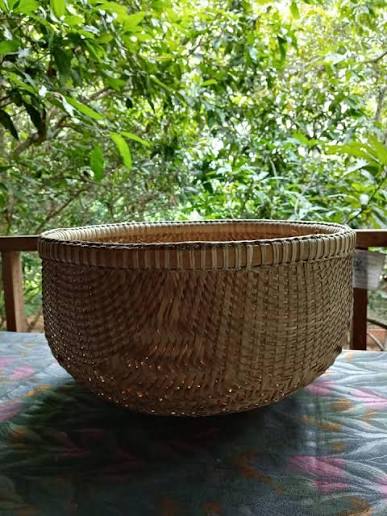
កញ្ជើ
Kanhchoe · Woven bamboo basket
Grandmother · Kampong ChamA kanhchoe is carried on the hip or the arm, set down on the floor, emptied, and hung back up. Because the weave breathes, it holds the things that would spoil in a sealed bag — vegetables waiting to be cooked, fish coming back from market, rice being rinsed and drained. The same basket goes from market to kitchen to under the house without being washed in between, and when it finally splits it is handed down to a dirtier job rather than thrown out.
Basket and mat weaving in bamboo, rattan and palm is one of Cambodia's oldest continuous crafts, documented back to the Angkorian period (9th–15th century) alongside stone carving and pottery. Weavers work by coiling, plaiting or twining depending on what the object has to do; an open basket like the kanhchoe is plaited loosely on purpose, so rice, vegetables or fish can drain and breathe through the gaps. Siem Reap and Kampong Cham are still known weaving regions.
The craft came close to disappearing during the Khmer Rouge period (1975–1979), when many skilled weavers were killed or displaced and workshops closed along with most non-agricultural trades. Weaving villages have revived since the 2000s, though plenty of households never stopped making baskets for their own use regardless of whether anyone was buying them.