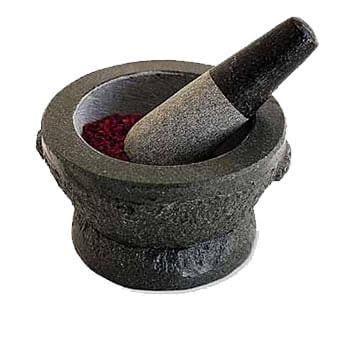
ត្បាល់
Tbal · Stone mortar and pestle
Grandmother · Kampong ChamWeight is the whole point. A tbal is not lifted onto a counter and put away again; it stays where it is used, and the stone's own mass does the work, so the pestle is dropped rather than driven. The bowl is deep and narrow to keep the paste under the pestle instead of spreading out the way it would on a board, and the pounding surface is left slightly rough so the aromatics have something to catch on.
It is the kroeung tool above all. Kroeung is the pounded paste — lemongrass, galangal, turmeric, kaffir lime leaf, garlic, sometimes fresh chilli — that sits underneath amok, samlor, and most Khmer curries, and it is built in the mortar in order, hardest ingredient first, each one broken down before the next goes in. The same mortar makes the everyday things too: chilli and garlic crushed for a dipping sauce, roasted peanuts broken up for a salad.
Mortars are hand-carved from granite in the stone-working villages of Kampong Thom province, where artisans at the foot of Phnom Santhuk still quarry and cut stone by hand — the same craft tradition behind the sculpture at Angkorian temple sites. A mortar is chiselled out of a rough boulder into a bowl and then smoothed where the pounding happens: heavy, deliberately imperfect work meant to survive decades of daily use. Cambodian Cookbook calls the tbal "THE Cambodian tool" and advises buying the heaviest one you can manage, since stone "bruises fibre and oil" out of lemongrass and galangal in a way a blade never fully replicates.